Ciriaco Campus. Cartoline per la Pace
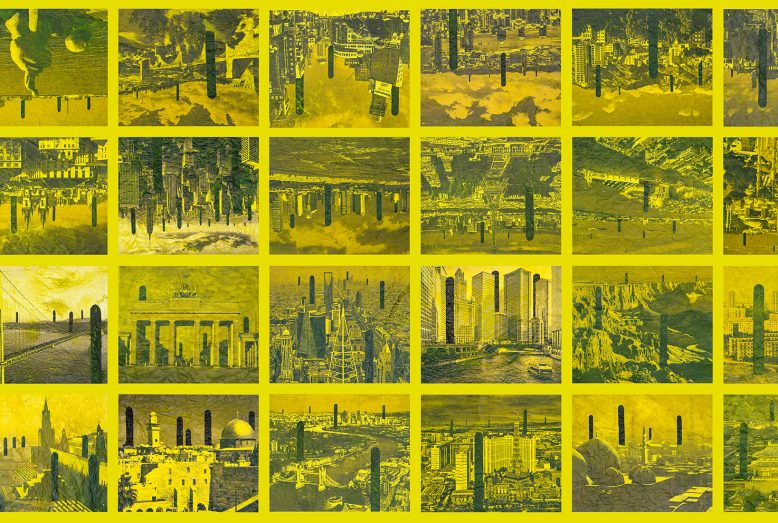
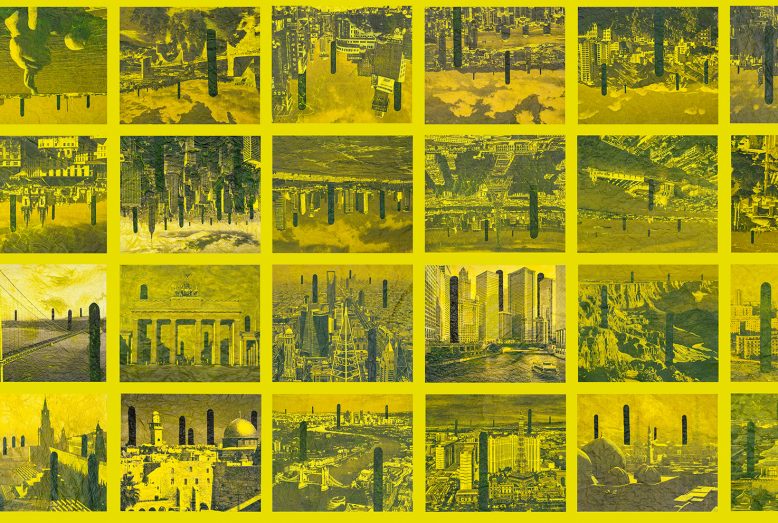
Ciriaco Campus. Cartoline, 2023. Printed image, industrial paint and acrylic on cardboard, each 62.5 × 52.5 cm. Courtesy of the artist.
March 26, 2026 – June 2026
Opening: March 26, 2026
Metro Line A Platform – Anagnina Station
with the participation of the artist and
Eugenio Patanè, Councilor for Mobility
Massimiliano Smeriglio, Councilor for Culture and the Coordination of Initiatives Related to
Remembrance Day
Sabrina Alfonsi, Councilor for Agriculture, Environment and Waste Cycle
Paolo Aielli, CEO ATAC
We are living in a time in which peace—painstakingly achieved in the aftermath of two world wars—has once again become fragile, reversible. Rearmament now occupies the center of political discourse. While diplomacy is progressively marginalized, weakened by autocratic logics, the nuclear threat is increasingly normalized. Yet peace is not an abstract idea. Peace belongs to everyone. Cartoline per la Pace stages an everyday future in which intercontinental missiles occupy schools, residential buildings, monuments, stations, and public squares: cities that symbolize collective life transformed into landscapes of threat. Yellow functions as a warning color—a sign of adaptation shaped by toxic imaginaries administered through mass media, social media, video games, and the internet, which render war perceptible as normality. Cartoline per la Pace invites to imagine a new sociopolitical horizon grounded in cooperation, dialogue, and a renewed commitment to global disarmament.
Peace is a fundamental human right.
A responsibility toward present and future generations.
The most precious common good.
Cartoline per la Pace is a public installation realized inside six wagons on Rome’s Metro Line A, circulating daily along the Anagnina–Battistini route from March through June 2026. The images belong to the artist’s 2023 cycle of paintings on cardboard, Cartoline, depicting some of the world’s most iconic cities “colonized” from within by the silhouettes of intercontinental missiles—dystopian, extraneous, and intrusive presences embedded within the urban skyline.
Printed on adhesive film, the images almost entirely wrap the wagons of the metro, generating an immersive environment inviting passengers to reflect on peace as a common good.
Ciriaco Campus was born in Bitti (Nuoro) in 1951. He has taught sculpture at the Academies of Fine Arts in L’Aquila, Milan, Sassari, Naples, and Rome. He lives and works in Rome. His research operates within a field of inquiry that critically examines contemporary regimes of visibility, placing at its core the mediated representation of social issues as a device for the production of reality. His work does not merely observe content; rather, it analyzes the infrastructural, symbolic, and economic conditions through which such content is made visible, circulates, and acquires value—thereby contributing to the construction of collective imaginaries and forms of subjectivity.
By exploring the underlying logics of global society, the artist reveals the contradictions that emerge in the relationship between consumerist imaginaries and the epistemic reliability of the social. Among his most significant exhibitions in public institutions are those held in Rome at the Galleria Comunale, Castel Sant’Angelo, Palazzo Venezia, the Auditorium Parco della Musica, and the National Gallery of Modern Art; at the Palazzo Reale in Naples; and at the 54th Venice Biennale.
His works are included in both private and public collections, such as the National Gallery of Modern and Contemporary Art and the Farnesina Collection.
Dates and Opening Hours: March 26 – end of June 2026
Daily access with a valid metro ticket: 5:30 AM – 11:30 PM
Fridays and Saturdays: 5:30 AM – 1:30 AM
Location: Metro Line A, Battistini – Anagnina
Cartoline per la Pace is promoted by ATAC and the City of Rome (Department of Mobility |
Department of Culture and the Coordination of Initiatives Related to Holocaust Remembrance Day |
Department of Agriculture, Environment, and Waste Cycle), in collaboration with Nomas
Foundation
Curated by Raffaella Frascarelli